RESOURCE
Overview of Commercial Sound Coverage Planning
Determining the correct number and spacing of loudspeakers is critical to achieving even sound distribution and avoiding sound dead spots or harsh hot spots. This guide covers the mathematical principles behind coverage overlap and ambient noise compensation.
Step 1: Determine Ambient Noise Levels and Target SPL
A commercial public address or background music system must overcome ambient noise levels to remain clear and intelligible.
- Quiet Office / Library: Ambient noise ~ 45–50 dBA → Target SPL: 60–65 dBA
- Retail Store / Restaurant: Ambient noise ~ 60–65 dBA → Target SPL: 75–80 dBA
- Industrial / Factory Floor: Ambient noise ~ 80–85 dBA → Target SPL: 95–100 dBA
Rule of thumb: Voice announcements must be at least 10–15 dB above the ambient noise level for reliable intelligibility.
Step 2: Ceiling Speaker Coverage Calculation
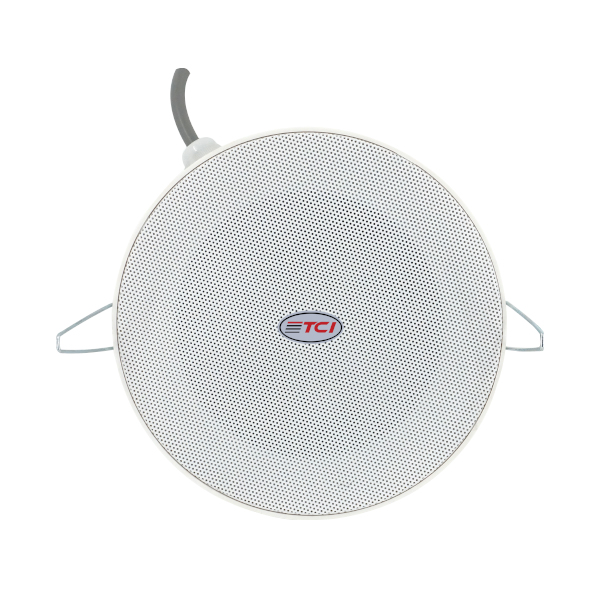
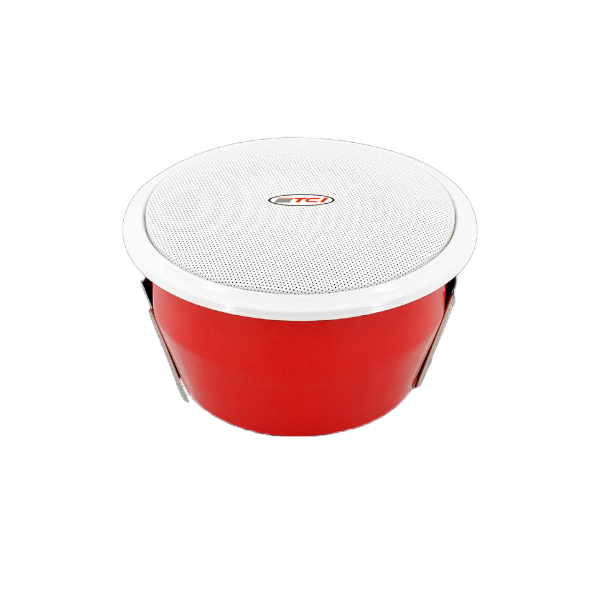
Ceiling speakers project sound downwards in a conical dispersion pattern (typically 60° to 120° dispersion angle).
Formula for Coverage Radius:
r = (Ceiling Height - Listener Ear Level) × tan(Dispersion Angle / 2)
Assuming standard listener ear level is 1.2 meters (seated) or 1.5 meters (standing):
- Calculate Listening Distance (h):
h = Ceiling Height - 1.5m - For 90° Dispersion angle: Radius
r = h. Coverage diameterD = 2 × h. - Overlap Strategies:
- Edge-to-Edge: Center-to-center distance between speakers equals
2 × r. Provides economic coverage for background music. - Minimum Overlap: Spacing equals
1.4 × r. Recommended for high-intelligibility public address and voice alarm systems.
- Edge-to-Edge: Center-to-center distance between speakers equals
Step 3: Calculating Amplifier Power Requirements
Once speaker quantity is established, sum the transformer tap values (e.g., 20 speakers tapped at 6W = 120W). Always add a 20% headroom factor to prevent amplifier clipping:
Required Power = Total Tapped Power × 1.20