RESOURCE
Introduction to Audio Impedance in Commercial Installations
When designing a commercial or industrial public address (PA) system, one of the most fundamental decisions is choosing between a low impedance system (4–16 Ohms) and a high impedance line system (70V / 100V). Understanding the mechanical and electrical differences between these two configurations ensures optimal acoustic performance, safety, and cost efficiency.
What is an 8-Ohm (Low Impedance) Audio System?
Low impedance audio systems connect loudspeakers directly to the power amplifier without intermediate transformers. The total load impedance typically sits between 4 Ohms and 16 Ohms.
- Key Characteristic: High-fidelity sound reproduction with wider frequency response and lower harmonic distortion.
- Best Suited For: High-end music playback, recording studios, home theaters, and small venues requiring dynamic range (e.g., bars, boardrooms).
- Limitation: Cable distance is severely limited. Cable resistance over long distances causes significant power loss and dampening factor degradation. Furthermore, connecting multiple speakers in parallel drops total impedance, which can overload the amplifier.
What is a 100V (High Impedance / Constant Voltage) Line System?
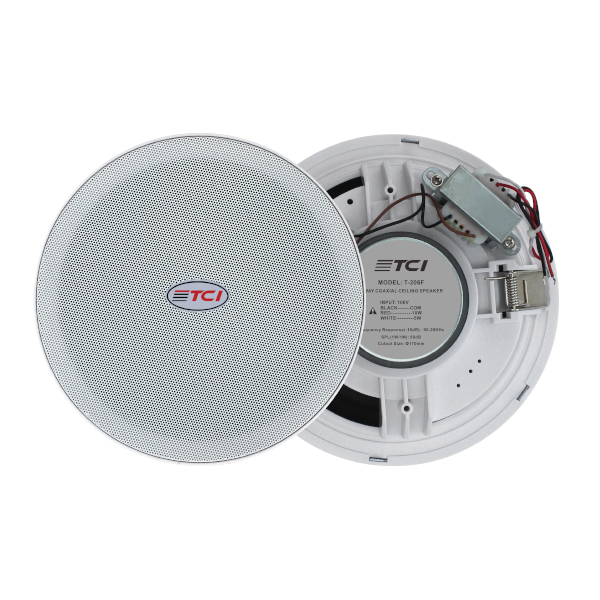
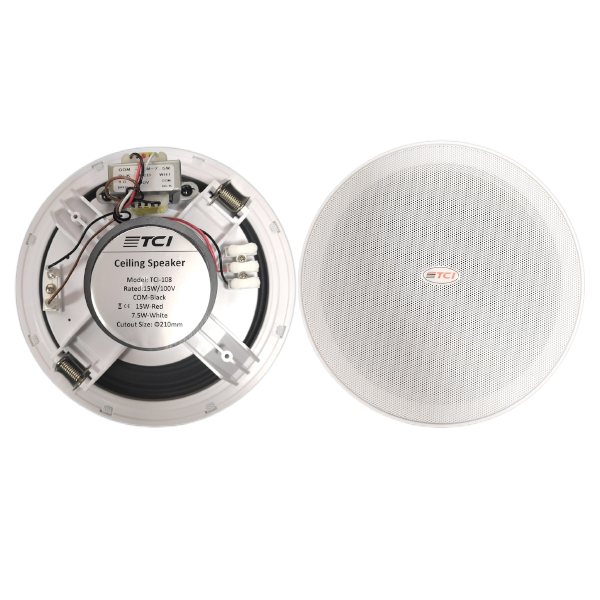
A 100V line system (commonly 70V in North America) uses step-up transformers at the amplifier output and step-down transformers at each loudspeaker. This raises the transmission voltage and lowers the current, allowing long cable runs with minimal signal loss.
- Key Characteristic: High efficiency over extreme cable lengths with simple parallel daisy-chain wiring.
- Best Suited For: Shopping malls, airports, factories, schools, and outdoor public address or emergency evacuation systems.
- Advantage: You can connect dozens or hundreds of speakers to a single amplifier channel, provided the total speaker wattage transformer taps do not exceed the amplifier's rated output power.
Comparison: 100V Line vs. 8-Ohm
| Feature | 100V Line System (High Z) | 8-Ohm System (Low Z) |
|---|---|---|
| Wiring Style | Parallel / Daisy-chain | Series / Parallel matching |
| Cable Distance | Long (up to hundreds of meters) | Short (typically under 20 meters) |
| Speaker Capacity | High (limited only by amplifier wattage) | Low (limited by impedance load) |
| Audio Quality | Optimized for voice clarity & background music | Full-range high fidelity (Hi-Fi) |
Summary Checklist for System Design
Choose a 100V system when coverage area, speaker quantity, and simple installation are priorities. Select an 8-Ohm system when audio fidelity, stereo imaging, and high-energy music performance are paramount.